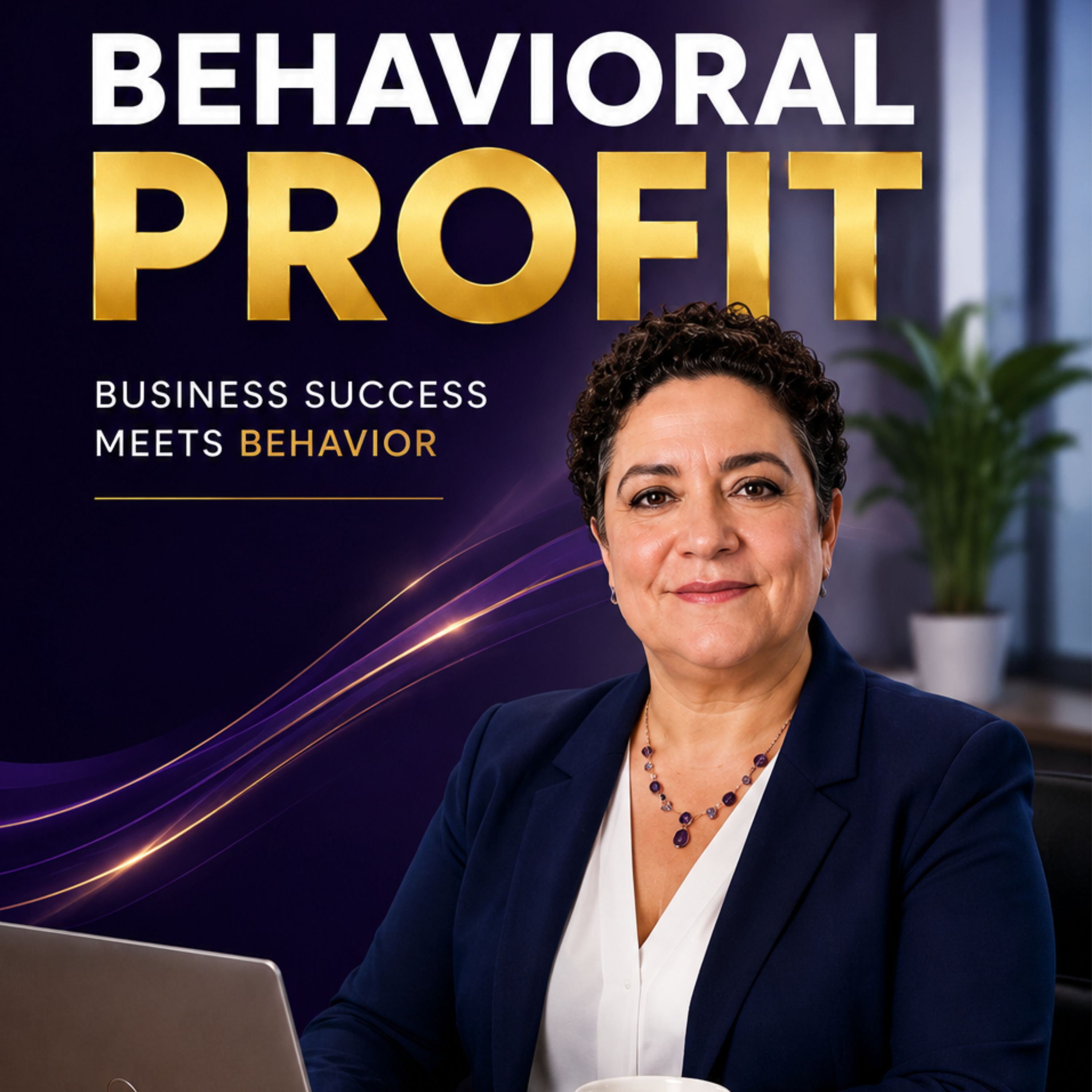
In this episode of Behavioral Profit, Debbie Longo speaks with Jonny Havey, founder of eLearning Partners, about identifying hidden profit leaks, improving employee and customer education, and creating measurable business growth through behavioral alignment.
Drawing on his background as a former CPA and IT auditor at PricewaterhouseCoopers, Jonny explains why many businesses work harder instead of smarter, investing time and money into activities that fail to produce meaningful returns.
Throughout the conversation, Jonny emphasizes that employees and customers both expect a return on investment. Employees want purpose, appreciation, growth, and meaningful work, while customers want to maximize the value of the products and services they purchase. When businesses align with those expectations, engagement, retention, and profitability improve.
Debbie and Jonny discuss leadership, workplace positivity, communication, mentoring, employee development, and creating environments where people want to contribute. Jonny also explains his approach to identifying profit leaks by treating expenses as investments that should produce measurable returns. Using the Pareto Principle, he helps organizations simplify operations and focus on the activities that create the greatest impact.
The conversation also highlights how mission-driven organizations can increase profitability while expanding their positive impact by educating employees, improving customer outcomes, and aligning business decisions with long-term purpose.
This episode explores leadership behavior, employee engagement, customer education, business growth, workplace culture, profit optimization, communication, productivity, and creating win-win outcomes for businesses, employees, and customers.
Jonny also explains why education is not just training, but a business growth tool. When employees understand their impact and customers understand how to get better results, companies create stronger relationships, reduce waste, improve retention, and build a business that is easier to scale.
Contact Debbie Longo, Executive Behavioral Coach:
Behavioral Profit
Website: https://www.debbielongo.com/
Email: debbie@lifeinbloomny.net
LinkedIn: https://www.linkedin.com/in/debbie-longo-life-in-bloom-ny/
Facebook: https://www.facebook.com/debbie.longo.2025
Instagram: https://www.instagram.com/debbie.life.in.bloom.ny/?hl=en
Contact Jonny Havey, MBA | Owner
Native American & Hispanic Business Owner
eLearning Partners | We save organizations multi-6-figures per year while scaling their impact globally
Website: www.e-learningpartners.com
Email: jonny@e-learningpartners.com
LinkedIn: linkedin.com/in/jonnyhavey
YouTube: https://www.youtube.com/@e-learningpartners
Join The Plug The Profit Leak Challenge: www.PlugTheProfitLeak.com
Welcome to the Behavioral Profit Show, where
we look at the behavior behind business results.
I'm Debbie Longo, executive behavioral coach.
And on this show, we go beyond strategy and talk
about decisions, communication patterns, leadership
behaviors, and internal shifts that shape trust
culture, performance, and profit. Today's conversation
is about what really drives change. Not just
what people say they want, but the behaviors
that create the results they get. We have a very
special guest today, Johnny Havy. He is the founder
of eLearning. partners, a business consultant,
and former CPA and IT auditor at PWC. He partners
with forward -thinking business owners and teams
within S &P 500 companies to identify and eliminate
hidden profit leaks by turning education into
competitive advantage. Through his work, Johnny
helps organizations increase product adoption,
improve customer and employee retention, and
drive measurable profit growth. His approach
focuses on closing the gap between between what
businesses are doing and what customers and employees
need and what creates real lasting results. Good
afternoon, Johnny. Welcome to the show. Thanks
for having me. That'd be super exciting to be
here today. Thank you for being here. I just
gave a little bit of introduction. So is there
anything that you would like to add to that?
Biggest thing that I've learned over being an
entrepreneur for a decade plus is that what business
owners need to do and teams within S &P 500 companies,
these leaders in these large organizations is
really understand the return on investment that
their customers that they serve want to get and
what return on investment their employees want
to get. That's the most important thing. We exist
as businesses. serve our customers and to serve
our employees. Employees are as much customers
as ours, as our customers are. So when you really
understand the return on investment that these
two groups want to get, you're able to align
what your business does with that and really
grow and create impact. So that's really what
I've learned over the years and what I help business
owners and S &P 500 company leaders do today.
That's very good. And what happens, like you
said, the ultimate idea here. And the ultimate
goal here is to increase sales and profits. And
there's a hundred ways to do that, of course.
And your way really gets to the heart and the
meat of what's going on in the company and in
the industry. I find kind of as a business owner
myself and a former CPA, I believe that at the
end of the day, in order for a business to continue
running, you need profit. You just do. Profit
is a tool for us to serve more people. So if
you're running a business that is losing money,
you're actually doing a disservice to your employees
and you're doing a disservice to your customers
and the world because you can't keep going. So
what I like to do is go in and really help business
owners and these S &P 500 leaders identify these
gaps or these leaks that may exist, and then
plug them and grow revenue and decrease expenses
so that they can keep serving these groups, customers
and employees. back to the most obvious thing
is that every business has to increase sales
and profits. If they don't every year, eventually
they do. Not all businesses have a gain every
year. That's just a fact. But if they don't,
then they can't function. They'll eventually
go bankrupt and go out of business. So that's
why that's the ultimate goal. If I'm on the S
&P 500 or the stock market, now I have a complicated
business. I have people to answer to. I have
more pressure. to gain and increase my stock,
my value of my company. So there's a lot of pressure
and I'm not the one running the company. I have
stockholders, I have board members. So it really
makes it a lot more complicated, but obviously
the company winds up making a lot of money. That's
really the bottom line. To me, that is just a
really attractive thing. If it's a business owner
or an executive, do you want to increase sales?
profits, do you really want to make your company
really go thousand times better than other companies
in your industry? Do you really want to thrive?
That's the biggest thing that a business owner
probably thinks of all the time, but they don't
think of these little things that you're saying
and things that I do. I do it in a behavioral
way, but you do it in a little different. And
that's fine. Cause there's a lot of factors involved
that could be extremely complicated. Depends
on the business. It depends on how many employees.
they have when what kind of business it is. There's
tons of variables that are involved, but that's
really always going to be the most attractive
thing. Everybody wants to make money. Everybody
wants to have money in their pocket and numbers
that are really on paper that they can really
see evidence that the company is really successful.
And that's always a win -win. So that's always
what I go to. That's not the most important thing,
obviously, but that to me is the most attractive
thing for most businesses anyway. Really what
we want to create, Debbie, is a win -win -win.
Everyone should win. So it's when we align the
ROI of what employees are looking for, working
for an organization. Employees work for an organization
for a certain reason. Obviously we can, starting
really high level, they want to make some money,
but why do they want to make money? They want
to make money so they can support their families,
support their lives. They also want to have a
job where They feel appreciated and they can
grow. And for me, the reason why I even got into
what I do is create as big of an impact as possible.
Employees want to know that they're creating
an impact. So that's one piece is aligning what
employees actually want. And when you do that
and you give that to them, they're going to perform
higher, maybe more efficient and effective at
their job, which for the business owner or S
and P 500 executive, what that results in is
high. revenue and hopefully lower expenses, which
ultimately drives profit. When we look at customers,
same thing, when customers interact with our
businesses, they want to know that they're getting
a product or service that serves them and the
return on investment they're looking to get,
the payoff. And they want to understand how to
get the most out of it. This is one thing that
some of my clients that come to me is they have
the best product or the best service in their
industry. industry, but it's not that alone that
empowers them to be successful. What they need
to make sure they're doing is that their customers
understand how to get the most value out of a
product. That's where really one of the tools
I use to really serve both these groups, employees,
and customers is education. When we make it part
of our organization to educate our customers
on how to get the most of our products and the
most out of our services and how they can really
live better lives because of that, then we're
able to create the first one. When we're able
to educate our employees of what they're doing
is impactful and we're able to serve them in
a way that they live more fruitful lives. Then
that's the second one. And then the third one
is when you align those two pieces, then the
company themselves and Debbie and I have talked
about this already. We are able to increase profits.
So that's the third. So the company wins, employees
win, and the customers win. You create a win
-win -win. That's how you create impact in the
world. Exactly. And you covered it all. But to
me, this is only because this is what I do. The
most important thing, the first thing out of
all of that is that I need to change my behavior.
And as a business owner and an executive, because
you could do this if you just start a business.
It doesn't have to be a problem. You don't have
to wait until the business is a big problem.
where it's going bankrupt and whatever. So a
business owner can do this when they first start
a business, which is really the best thing. And
that starts with everybody being positive and
nobody's negative and nobody's controlling anybody.
People have job duties. They follow that. All
of these different things create a positive workplace.
That's the first thing. When that happens, then
I could go into all of... these are the parts
of the way that the organization is supposed
to run. And I want to follow all these things,
like you're saying, employee retention and product
adoption. I want to focus on that, but anything
I do, I want to go into it with a positive, no
negatives at all. And this is why big companies
are successful. This is the only reason why.
Their executives and CEOs, the ones in the stock
market, they're not negative. They don't control
their employees. They don't manipulate their
employees. employees, they don't create fear.
And this is the difference. And this is why they're
successful because we want the employees to follow
what the job duties that we give them. We don't
want the employees to control the business owner
and the executive. We don't want them to tell
them what their job duties are. We want to enforce
what the job duties are of the company. And when
you do that in a controlling way, then the employee
starts to rebel. And then the employee starts
to say, I'm going to do what I want, I'm not
going to follow what the company is telling me
to do, what the outline of my job is. So now
the employee is dictating to the business owner
and the manager what they want to do. And that
situation is not going to work out all because
the employee and the business owner created that
fear, that negativity, the controlling, the manipulation.
And that's why the employee does that. It starts
with the business owner and the executive or
whoever's the top person that's managing the
employee. employees or whatever, because that's
the person that we want to focus on, because
that's the one that's influencing the company.
And also this person could be a mentor, but you
don't know the employee. Maybe the employee wants
to change industries or something, or they're
interested in learning about a different type
of job. And the trainer or the business owner
is like their mentor and they want to teach them
and they want to get a completely different job
because they want to learn about it. So how are
they going to learn? to learn through whoever
teaches them in the company. And they have to
be positive. They have to be able to produce
this in a positive way. And that's how the employee
is going to get stuff. And you know what's going
to happen then? People are going to start calling
the company and they're not going to have a problem
getting employees. They're not going to have
a problem with employees trying to control and
manipulate them because they were controlling
and manipulating and creating fear and all of
that with their employees. And this is just a
cycle. It's just really the way that it works.
It's the way that every business works. Whether
you want to say it or not, this is the best way
to do it. And it'll be so easy to do. Yeah, Debbie.
It all starts from within. A business at some
point started with a founder or multiple founders
creating or bringing an idea to life. And when
you have a positive attitude, positive mindset
in that, you're going to attract positive. employees.
And when you attract positive employees, you're
going to also attract positive customers. So
it starts from within. When you do that focus
on the highest leverage parts of an organization,
it's going to be who is creating, who is responsible
for the most people in an organization. Could
be the business owner, could be the C -suite,
could be managers. As you grow as a business,
it's going to be all these. So when you align
the mindsets and make sure that you're pruning
and getting rid of anyone who doesn't align with
this positive mindset, then you're able to have
all the other pieces fall into place. And when
your employees are happy, they're going to serve
your customers better. And then the business
is able to grow even more because of it. And
that's really the bottom line. And that's the
most important thing. I'll ask a few of these
questions and then we'll talk about it. a little
bit, what is the biggest challenge your audience
or customers face that you help solve? So the
reason why I even got into being a business owner
is when I was at PricewaterhouseCoopers, I was
doing very good work. I was working on different
entertainment accounts. That's really why I even
wanted to work for Pricewaterhouse is because
I in college had a passion for movies and filmmaking
and telling stories and really creating impact
through stories and education. I created multiple
documentary films, worked with a couple Oscar
award -winning documentary film directors as
well. When I was at PricewaterhouseCoopers, I
saw how the company as a whole was impacting
the world, but I personally didn't feel like
I was. PwC is an amazing organization. It's why
they're the biggest of the big four accounting
firms talking about successful organizations.
But what I really... wanted to do was create
a company that could empower other business owners
and leaders to really increase profits and make
a meaningful impact. And in my early career as
a business owner, this was not my first business.
I realized that even with a strong vision, capable
team, and some momentum, I saw that businesses
were spending money on initiatives and spending
money on technology and spending money on different
things that really wasn't bringing ROI. And I
think it's easy to do. yourself spending money
on different things. Working harder, that was
another thing. Seeing businesses really work
harder and pushing their employees to work harder
and businesses, business owners working harder.
When I first started, I was working a hundred
hours a week because I thought that was the way.
That is really the biggest challenge that I help
businesses with now is simplifying in order to
scale. Coming back to the basics of serving your
employees. and serving your customers by really
identifying the return on investment that they
want in their lives. And then leveraging the
business, the services and products that a business
has to fill that ROI. Instead of doing all these
other things, spending money on all these things,
working more hours because that's what we're
taught to do. So it's really simplified. These
are all different ways of looking at how to make
a business. business become successful because
there are many moving parts and there are many
different theories and there are a lot of things
that we can do to help a business. Depends on
who you contact, who you want to help. And it
also depends on what kind of business you have.
It's really interesting. So in business school,
I learned the profit equation. So profit equals
revenue minus expenses. And recently I decided
to... ask AI what the definition of profit is,
what the definition of revenue is, and what the
definition of expenses is. And it gave me a very
interesting response. It's right on, actually.
But I don't think it's actually how businesses
operate. What A has defined profit equals revenue
minus expenses as is revenue is what is created
from selling services and selling products. It's
income into the business. Expenses, and this
is where it got really interesting. Expenses
are defined as anything that a business invests
in to operate. And I thought this was very interesting
because because that is what expenses should
be. I do find that businesses, including mine
in the early days, tended to spend money on investments
or expenses that had nothing to do with operating
the business. And I think that this definition
of the profit equation and really adjusting the
equation, where what I like to do when I'm writing
this up a board, write profit equals revenue.
And then instead of having minus expenses, I
draw a from expenses to revenue, because what
this does in our minds as a business owner and
as an S &P 500 executive, that whatever we are
spending money on needs to drive revenue in one
way or another. When I look at the equation,
I look at expenses as investment instead, and
I look at revenue as return. So we have investment.
pointing towards a return and then ultimately
creating profit. So this is what I really work
with my consulting clients with is simplifying
everything to are we investing in things that
are creating a return? And if we're not, then
let's install the Pareto principle in their business,
also known as the 80 -20 rule, which shows that
80 % of results are created by 20 % of activity.
or 20 % of N... So what I find is when we have
an organization that is ultimately looking towards
this great future and they have the positive
alignment within, and then they look at how do
we get all of our employees to focus on the investments
or the different activities in our business that
are able to create the most results for our customers,
then they're able to grow by simplifying instead
of creating a more complex business. Even large
S &P 500 organizations, I've seen this be very
successful because it comes back to what you're
saying, Debbie, where when you have leadership
who have the vision of this is where we're going,
then it becomes a lot less about here's all the
things that we've always done to get there and
a lot more about what are our customers looking
for today and how How do we align our team, their
time, the monetary resources that the organization
have? Let's put this into the 20%, creating 80
% of results. And we've really been able to exponentially
increase impact. That was very true. Thank you.
Can you share a client success story, case study,
or example that demonstrates the impact of your
work? I have a couple. One that I'm very passionate
about is... I've had this amazing consulting
client in Australia for the past year, and the
organization is called Celisol, which means well
-being for all. And the whole purpose or vision
of this organization founded by Mario is to...
help half the global suicide rate in the next
three years. This Dr. Benjamin Hardy would call
an impossible goal. But the reason why he set
this goal and we set this goal together for his
organization is to filter present day choices
and decisions and activities in the business
to work towards this goal. Before we worked together,
he was really focusing on creating impact on
a one to one basis. So B2C business to consumer,
which I feel like a lot of businesses do. And
I do feel like businesses do need a B2C business
to consumer and a business to business strategy.
When we're looking at creating global impact,
especially at the scale that Mario and Sellasol
is doing in the next three years, it can be a
higher leverage of his time and his team's time
to serve large organizations to, instead of just
going and putting one person here, one person
there through his library. programs that really
empower people to really be there for themselves,
but also empower them to be there for others
through his support over suicide program. Now,
since working together, we have installed a strategy
business to business where he is now in every
single sales transaction, able to serve not just
one person, but dozens, if not hundreds and ultimately
thousands of people. And we're talking about
employees of these organizations. What he has
been able to do is get his multitude of programs
to be D credits for employees to actually take
in Australia, so continuous professional development
credits. As a requirement, there is a specific
number of credits that employees need to take.
Depending on the industry, it's different, the
amount, but What the strategy is by having a
program that is able to create this global impact
of saving these lives and making it in a way
where the ROI is a win -win -win from the standpoint
of for the organization, by investing in a hundred,
a thousand licenses to his programs, the organization
is able to decrease turnover, employee turnover,
and it's a to, more importantly, especially in
Australia, this is a big problem, is to decrease
the number of sick days and mental health days
that employees are taking because they don't
have the support and the tools to really help
themselves and their colleagues with different
mental health challenges. He's done a lot of
research on this and just in Australia alone,
companies are sp - $1 million of the lack of
tools and programs in place to support individuals
in the mental health arena. So that's the win
for the businesses is to decrease the amount
of money that they're spending because of these
mental health challenges. The win for the employees
is they're able to really be happier and healthier
and have the tools they need to support themselves
and others. And then the win for Mario and Celisol
is getting closer and closer to halving the global
suicide rate. So I'm very happy with the work
we've done together. And really this is why I
do what I do, Debbie, is to be able to partner
with mission driven organizations like Celisol.
Or I also work with S and P 500 companies who
are supporting people and students in getting
jobs and getting paid more in their jobs by harnessing
the power of education. Really, the vision I
have for e -learning partners when I created
in the first place was to be able to empower
mission -driven organizations to change the world,
either through increasing hope. saving lives
or just making sure that people feel safe and
secure in their existence. And that's really
the organizations that I typically work with.
That's very important. And I thank you for doing
that work. And you could thank your friend too,
because this is all stuff. that we can talk about
for a very long time. And we just mentioned a
lot about the employees being happy, companies
being successful, different things, and it could
get very complicated. So this is another excellent
example. So we covered most of the topics. The
last one here is what is the most important message
or takeaway you would like listeners to remember
from our conversation? Ben, a business owner
for under 12 years now, and the number Number
one takeaway that I've really taken to heart
is when you are able to understand the problems,
the challenges that the people you serve. When
you're able to understand them even more than
they do. And then when you align that with a
solution that you can provide to make their lives
better, then you've done your job as a business
owner, you've done your job as a S &P 500 executive,
and ultimately you're going to create an impact
in the world. Agreed. And this is a good way
to end and summarize what we were talking about,
basically this whole entire podcast. We are getting
ready to close, so is there anything that you
would like to say in closing? And how can we
get in touch with you? And then I'm going to
put everything in the show notes. What I do,
Debbie, because my goal is to really help as
many business owners and S &P 500 execs as possible
is I've created what I call my Plug the Profit
Leak Challenge. It's a multi -day consulting
experience where I go live for multiple days
with C -level. with business owners, with mission
driven professionals to really uncover the profit
leaks that may be inflicting their business and
come up with a strategy to not only plug the
leaks, but help them scale. And the great thing
about this, Debbie, is I've had participants
in the challenge on day two. already find $100
,000 or more in their business without having
to bring in more sales, without having to do
anything, we were able to uncover six figures
plus in their business. If you are a business
owner or a enterprise leader to come to my next
Plug the Profit League challenge. That is amazing.
And you can really get some really unbelievable
results from doing these things. That's why all
of these things that we mentioned are so important.
We all know that the ultimate goal is to increase
sales and profits. That's obvious because everybody
makes money. Everybody's successful. Everybody's
happy. That's obvious, but there are so many
moving parts and so much that comes in between
and so much that can benefit just from a company
being successful. We've already talked about
tons of them. I thank you for being on and thank
you for listening to the Behavioral Profit Show.
gave you a new way to think about leadership
behavior, communication, or business growth.
Make sure to follow the show so you don't miss
future episodes. You can also learn more about
my work, upcoming episodes, and guest opportunities
on DebbieLongo .com. I'm Debbie Longo, executive
behavioral coach, and remember when you understand
the behavior behind the outcome, you can create
stronger decisions, better communication, and
more profitable results. And I thank you, Johnny,
for being on the show tonight. Thank you, Debbie.