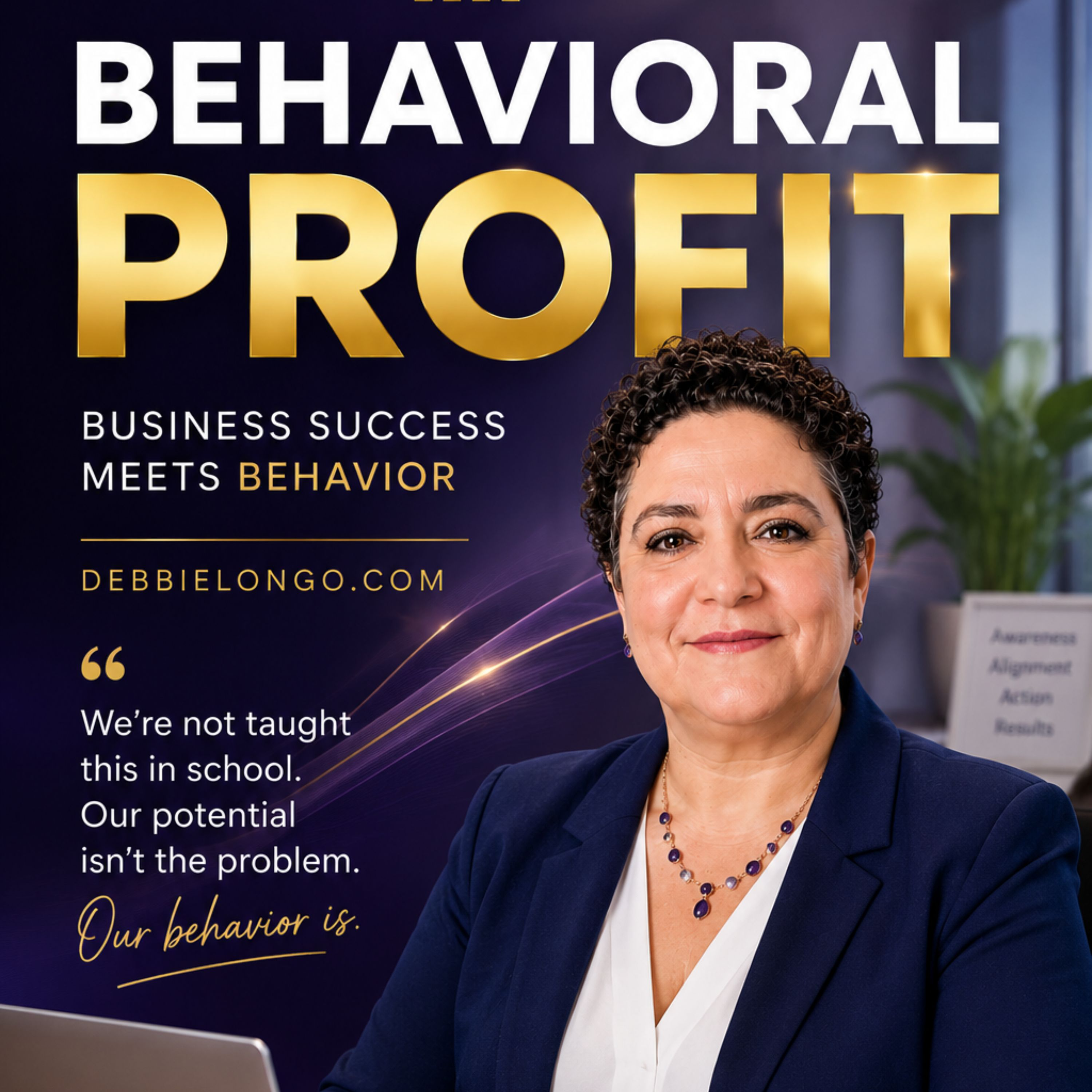
In this episode of Behavioral Profit, Debbie Longo speaks with Muriel Touati, founder of Exit 3D Studio and author of The Valuation Gap, about founder dependency, business valuation, delegation, and the behaviors that determine whether a business can scale or be sold.
Drawing on her experience evaluating business acquisitions, Muriel explains why many companies appear valuable on paper but lose value because they rely too heavily on the founder. She shares examples where sales, client relationships, operations, or lead generation could not function without the owner’s direct involvement.
Debbie and Muriel discuss why entrepreneurs struggle to delegate. Fear of losing control, perfectionism, lack of documentation, and difficulty trusting others often prevent founders from building businesses that operate independently. These behaviors may seem productive, but they limit growth and reduce long-term value.
Muriel explains that buyers evaluate far more than financial statements. They examine recurring revenue, customer concentration, leadership structure, documented systems, acquisition channels, and whether the company can continue operating if the founder steps away.
The conversation also explores SOPs, automation, mindset, trust, rejection, control, leadership development, and how entrepreneurship often becomes a personal growth journey. Muriel shares practical ways to reduce founder dependency, including documenting repeatable processes, building systems others can follow, creating lead generation beyond the founder’s personal network, and stepping away long enough to see what breaks.
Debbie emphasizes that leadership behavior directly impacts employee performance, communication, workplace culture, customer experience, sales, and profitability. Together they explain that businesses become more valuable when they develop people, build repeatable systems, and reduce dependence on one individual.
This episode explores leadership behavior, delegation, business valuation, founder dependency, recurring revenue, workplace culture, business systems, entrepreneurship, organizational growth, and building a company that creates lasting value beyond its founder.
Contact Debbie Longo, Executive Behavioral Coach, Founder and CEO Life In Bloom NY
Behavioral Profit
Website: https://www.debbielongo.com/
Email: debbie@lifeinbloomny.net
LinkedIn: https://www.linkedin.com/in/debbie-longo-life-in-bloom-ny/
Facebook: https://www.facebook.com/debbie.longo.2025
Instagram: https://www.instagram.com/debbie.life.in.bloom.ny/?hl=en
Contact Muriel Touati, Founder & CEO Exit 3D Studio
Exit 3D Studio: exit3dstudio.com
LinkedIn: linkedin.com/in/murieltouati
YouTube: youtube.com/@exit3dinsights
Free first chapter of The Valuation Gap: exit3dstudio.com/the-valuation-gap
Welcome to the Behavioral Profit Show, where
we look at the behavior behind business results.
I'm Debbie Longo, Executive Behavioral Coach.
And on this show, we go beyond strategy and talk
about the decisions, communication patterns,
leadership behaviors, and internal shifts that
shape trust, culture, performance, and profit.
Today's conversation is about what really drives
change, not just what people say they want, but
the behaviors that create the results they get.
I have a very special guest today, Muriel. She
is the founder and CEO of Exit 3D Studio and
the author of The Valuation Gap, What Buyers
See That Sellers Miss, launching July 27, 2026.
A French entrepreneur based in New York City,
she helps B2B service business founders build
revenue that is predictable, scalable, and transferable.
So the business grows stronger whether they're
scaling, stepping back, or preparing to sell.
She brings a rare buyer side. perspective, having
evaluated 100 plus deals, gone through full due
diligence and walked away from a signed deal
when what was being sold didn't match what had
been presented. That experience combined with
a decade long background in digital marketing
shapes how she helps founders build businesses
that grow stronger and become more valuable over
time. I'd love to talk today about why founders
struggle to let go of control, even when they
know it's limiting their growth and what costs
them when it's time to scale or sell. Good afternoon,
Marielle. Welcome to the show. Good afternoon,
Debbie. Thank you for having me in the show today.
And thank you for being here. I appreciate it.
The first topic is, like I had said, why founders
struggle to let go of control, even when they
know it's limiting their growth and will cost
them time to scale or sell, right? Why founders
struggle to let go of control? Can you talk about
that a little bit? As a prospective buyer, I
can say it is a problem that the founder cannot
let go because it will be hard to transfer. And
after, if I take my operator entrepreneur hat,
I can say that sometimes it's hard to let go.
When we are able to do everything ourselves,
we think we do it better than anyone else and
it's just hard to delegate. Personally, I know
I tend to be more comfortable delegating with
an automation that I have set up, and I've tested
it, and I know this is working than a person,
because I've been through that several times.
And it's probably not good to say that for every
task, for sure. But some of the tasks where I
needed help, I Sometimes you have to go through
a lot of training and the person will go or go
to training. You work with them sometimes and
they still go. So you're always back with yourself.
And I mean, for those who work on their own a
lot or have a very small team, I am sure that
they will feel that way as well. Yeah, and that
was very good. Thank you because for me that's
true also, you know, because I'm a coach I'm
a business owner, you know all of the above it's
difficult, especially if the company is doing
good and They're successful and they're increasing
sales and profits, you know, and that's just
a normal thing And normally we want to control
anyway, you know, that's just like a human thing
basically, but if it's done like to excess or
where it can create an issue where you start
to control employees and other people because
nobody can tell anybody what to do. Nobody can
make anybody do anything, right? Because we have
the ability to think for ourselves and act on
ourselves for ourselves. Yeah, I think we have
to see it as a risk. And if the owner gets sick,
Or the owner needs vacation or the owner needs
to take care of a family member or something.
It's a risk because this cannot happen to him
or if it happens then the business just collapse
or stay in standby until it gets better or it
gets back. So maybe we need to see this as a
risk. Yeah, agreed. that's probably going to
be what it is going to be. And the bottom line
of it all, that's what it's going to wind up
to be. So when they know it's limiting their
growth, so we kind of just talked about that
a little bit, right? So what costs them when
it's time to scale or sell? So what do you think
about that? Can you respond to that? To scaling
the sale of a business? There are different ways
to do that. I think one of the first ways, and
I take my perspective by heart saying this, is
looking at the quality of the revenue, the business
model even. Is it project -based work? Meaning,
do you need every month or every quarter to win
new business to keep going and make money? or
do you have a way of having recurring revenue
so any new client add a new layer of revenue
on top of the previous one. I think this with
this model it is easier to scale over time because
you're not losing clients all the time. And I
have a great example here. For example, I was
evaluating a photography studio. He had a great
reference, great brand he worked with two years
ago. For the past two years, he had family, things
to take care of, health issues, no more business.
So the business just stopped. And yet, it still
wants you to sell it for a million dollars, a
business that don't have any more revenue. So
they're saying for growing, scaling is better
to have recurring revenue. And that's just pretty
much what we were just discussing also, a part
of what we were discussing. And when that happens,
when you have scaling, you think that you need
to sell, and you don't have that reoccurring
revenue even after you scaled, then maybe something
is going on also in the workplace. Maybe something
needs to be changed. That's going to cost me
money. It also could cost me my company. My company
could go bankrupt. It could go out of business.
But these are decisions that businesses make
all the time. And these are very, very, very
important decisions, you know? I think for a
business owner would be in the situation where
he or she has only project -based work. Well,
this is, again, a reason to reduce the founder
dependency here because it is very important
that the founder step back a little bit, get
a new perspective and work on that, how to create.
more wealth for the business, how to create new
offers and just take that time while the business
keeps running, for example. Yeah, and that's
very true. And that's very correct because this
is what businesses do all the time. This is a
very, very, very common scenario. These things
that we're talking about here and these are very
important subjects, I think, to talk about because.
somebody has to be able to get something out
of this, a listener, or just somebody that can
relate to this. If you could talk about some
concrete examples from deals that you've evaluated
as a buyer where the founder was technically
not bottlenecked on paper, but was in practice.
I would say the deal where I... I mentioned the
photography studio, obviously this one, but the
deal where I got my offer accepted where technically
he had a team and he was still the general manager,
but he had so many different departments with
somebody that was managing, let's say the marketing,
managing the sales, managing the operation. So
you could think they have some management layer,
so he's not involved. But when I was evaluating
everything, for example, in the data room, there
were some sales calls video. And I was seeing
the sales person there was doing the demo alone.
But for the second call, like the closing call,
who was there? The owner. So it was It's like
sales was not fully independent. It delegated
a part of it. But without him, probably half
of the sales wouldn't happen. This was an example.
Also, another one, it was using... Let's say
most of the business was coming through LinkedIn.
And more specifically, through the LinkedIn profile
of the founder. So... This again was an issue
because the LinkedIn profile of the founder was
not part of the sale. It was excluded. So it's
like you're cutting the main acquisition channel.
You need the founder to close. There was, yeah,
every founder depended on this one. Even if on
the surface, it looks like they had a management
team. Things was working great. They had some
clients coming in. Also a lot of clients leaving,
this is another topic. And that's very good too,
you know. And this goes back to, you know, what
we were saying. Because when you have a business
and you have a team, everybody has to be involved.
Everybody has to decide whether the business
is going to be successful or not. And that's
up to the whole entire company. It's not just
one or two people or 10 people, you know, it's
everybody in the company. And that's really the
most important thing. So that was good. So why
documentation and delegation are harder than
they sound? And what's really stopping founders
from doing it? Yeah so why delegation is harder
than it sounds? I guess because to delegate you
need to prepare like for example documenting
what is it that you do to be having someone else
doing it like such as creating SOPs and stuff
like that and this can be a bit time consuming
if you want to do it well and you want someone
else to do it exactly. but the good thing i think
these days is depending on the task you can also
build or have someone build an automation for
you so maybe you explain it once you show it
once but then after you run automatically exactly
the way you want it it works for a lot of things
not for everything but it's i think this is one
of the reason Sometimes it's hard to be delegating
because of the documentation just to resume what
I said to the documentation of documenting what
the different tasks and after also finding the
right person to do it or building that automation
and building it well. And so like I'm a behavioral
coach too so this really goes in line with what
I say and what I teach because a lot of clients
come to me and they have these types of issues
too, where they have an issue with delegating
and putting things down on paper and evaluating.
And that is the bottom line is that's going to
affect, and this is part of what you said also,
is that's going to affect the bottom line. It's
going to affect the sales and profits. You could
say me not delegating equals this, equals an
employee getting angry, equals me arguing with
an employee, equals the employee quitting. And
there's tons of steps that go in between. Right,
but the bottom line is that that is going to
decrease just one problem with one employee is
Most likely going to wind up decreasing my sales
and profits and then you times that by 10 times
by a hundred and this is why This happens to
these businesses So this is why this topic is
these things here that we talk about very important
because it just sounds like one little thing
Just one little problem, but it's not. You work
also on the mindset to be able to be, I understand
that is also very, very important to learn to
let go, to trust, all those things for sure.
Often being an entrepreneur, it's self -development.
journey because you have to fight all the fears
or all you don't want to face, you have to face
it. You have to do a call or something and you
get rejected or you have to face your rejection
issue or if an employee leaves, wow, abandonment
issue. Like all those things that you actually
have to work on as an entrepreneur. and building
a business, it's going to trigger, I think, all
your trauma. It has to. But it's a good tool
also, being an entrepreneur, to resolve all this
trauma, you know, work on everything in a healthy
way, in a practical way. So it's good to take
the risk. This is how these things start. It
could wind up to be a problem or it could wind
up to be successful. And this is how I start
a business or this is how I form my business.
This is how I create my job duties and whatever,
however else I'm going to make my business. And
it could go either way. And that's the bottom
line. So that's why we want to make sure that
we're doing everything right when we start a
business, get a coach or somebody that can help
them go through this process in order for them
to be successful, and that's really the bottom
line. What a business needs to look like to run
without its founder and the first concrete step
to start building that. For the business to run
without its founder, first of all, we need an
acquisition engine to get a new client that is
not dependent on the founder. That means having
different channels, ideally. A referral doesn't
count. Referral is a bonus. If you get referrals
or recommendations, that's fantastic. But you
need to have a way to generate leads outside
of the founders and directly to the business.
That's one thing. Another thing is probably the
decision. having other people in the business
to be able to take decisions and audit a bit
what the founders do and see what can be delegated
and start there, start documenting, raising SOPs
and recording the screen, trying to delegate
more. And one of the concrete ways to see where
to start is live for two, three days and see
what breaks. This will be the first things you
will need to be solving. Maybe it was giving
the power to someone else to take that decision
or ending that relationship with a client to
someone else. Could be someone else doing the
cold calling if it's what you are doing usually
to bring new business. Yeah, so all of these
details are the the the details the explicit
things, you know that we need to do that a company
is already developed and then they will be able
to run without the founder because if somebody
if a business owner or an executive develops
the business properly then they could take, everybody
takes their job duties, everything, their job
descriptions, everything that they do every day,
and they just do it. It's an automatic thing.
And now the business is running, right? And what
you explained is just basically like a lot of
the details of that. And those are good tips.
Those are good things to take into consideration
if I want to run a business like that, where
maybe the founder goes someplace else, Or they
have another business, they buy another business,
something like that. And that is truly a successful
business. And that takes a lot of negativity
away. It takes a lot of control away. It just
does a lot of positive things. when the business
can run without the founder. So the first concrete
step to start building that, I think we talked
about that, right? So that was just basically...
Yeah, yeah, I think I mentioned it before. The
first thing to do that is to step away to see
what breaks and just correct what is breaking
when you leave, because you will depend of the
business and what the business owner is doing.
Another thing is maybe try to... generate like
one lead online instead of going networking or
waiting that partners send a lead to you. Just
try to find someone completely out of your network
and transform it into your client. This is a
good thing to do also to start. building something
that's when a sales engine that run outside of
you. Yeah, agreed. Very, very true. And these
are, like I said, these are very, very, very
important things for a business to really hear
and really listen to. And maybe somebody could
get something out of this, hopefully. So this
was very, very good conversation. Is there anything
that you would like to say in closing? and how
can they get in touch with you? Yeah, in closing,
I will say I dig into this more in detail in
my book, The Valuation Gap, What Buyers See That
Seller Miss. It's a step -by -step guide to evaluate
your business the way a buyer would, so you can
correct, fix what is capping your growth right
now and build. a business that is worth keeping
or selling inside at the end of its chapter there
is what I call the buyer lens with several questions
and answers and so you can evaluate where you
know you are and is it you have problems of customer
concentration is it what you should fix first
or is it founder dependency or the quality of
the revenue or something else and to get in touch
with me on my website exit3dstudio .com it's
possible to book a call directly with me you
can find me on linkedin murielle20 so maybe it
will be in the show notes but murielle from exit3d
studio and you'll find me on linkedin and also
i have created a new youtube channel called exit3dinsights
where i share all those podcasts and interviews
in our dedicated playlists and also some more
insights about creating a business that is not
dependent on you, a business that runs without
you. Perfect. Thank you very much. I really appreciate
it. This was a very good conversation. And thank
you for listening to the Behavioral Profit Show.
If this conversation gave you a new way to think
about leadership, behavior, communication, or
business growth, make sure to follow the show
so you don't miss future episodes. You can also
learn more about my work, upcoming episodes,
and guest opportunities at DebbieLongo .com.
I'm Debbie Longo, executive behavioral coach.
And remember, when you understand the behavior
behind the outcome, you can create stronger decisions,
better communication and more profitable results.
Thank you very much for being on the show. I
appreciate it. Thank you, Debbie.